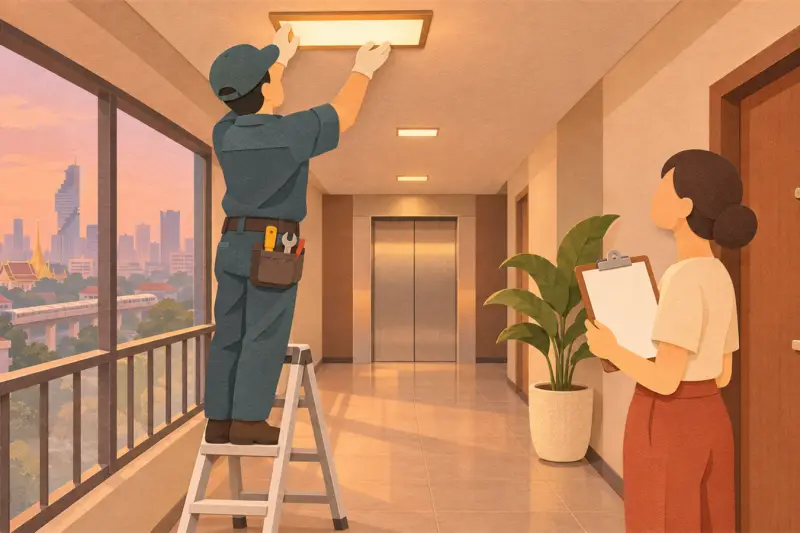
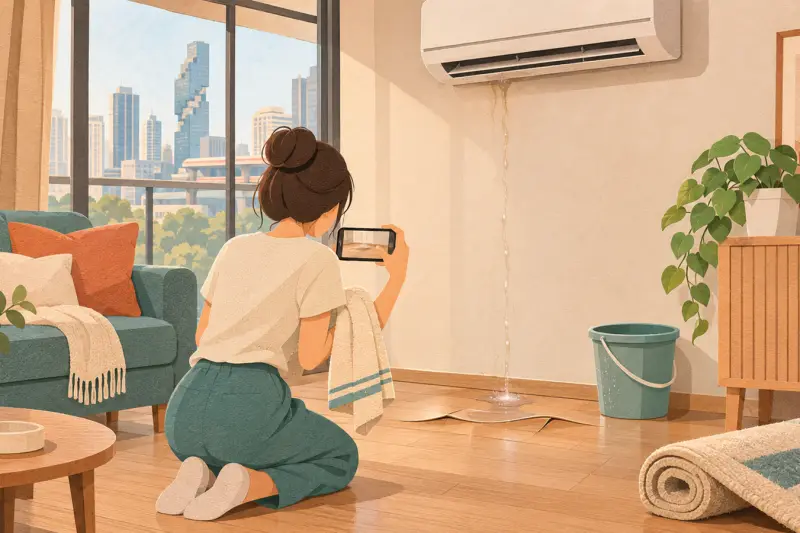
If you notice water seeping in and causing the floor to swell, first stop the water, take photos, and notify the unit owner and the condominium juristic person (building management) in writing. Do not start removing or repairing the flooring yourself until you know where the water is coming from, as the cause determines who must arrange repairs and who must pay.
What to do as soon as you spot a leak
- Stop the water If the water comes from an obvious source inside the unit, such as a bidet spray hose, a tap under the sink or a washing machine drain hose, turn off the valve for that fixture or the unit's main water valve. If you do not know where the valve is, or water is coming through the ceiling or walls, call security or the building management office first.
- Watch out for electrical hazards If water is near a socket, do not touch it with wet hands. Move electrical appliances clear of the water. If a socket or appliance has got wet, have a technician inspect it before using it again.
- Move belongings and mop up the water Remove rugs and other absorbent items, then dry the floor as quickly as possible.
- Take photos and videos Record where the water is coming from, stains on the ceiling or walls, swollen flooring and damaged belongings, with the date and time visible.
- Report it in writing Send the owner a message with photos and notify building management through the building's designated channel. Ask a building technician to investigate the cause.
Where could water under the flooring come from?
- A blocked or disconnected air conditioner drain pipe, allowing water to run down the wall and seep into the flooring
- The bathroom, such as deteriorated grout around the shower or a leaking pipe beneath the washbasin
- A washing machine drain hose, pipes under the kitchen sink, or rain entering around window frames and sliding balcony doors
- Water from an upstairs or neighbouring unit seeping through the ceiling or walls
- A main pipe or communal pipe inside a service shaft or wall
Who needs to deal with it?
The Condominium Act B.E. 2522 (1979) divides a condominium into two categories: private property, belonging to individual unit owners, and common property, jointly owned by all co-owners and managed by the condominium juristic person. Section 15 lists common property, including structures and construction essential to the building's stability, parts of the building and equipment intended for shared use, and shared systems such as drainage and wastewater treatment.
| Source of the problem | Generally classified as | Who usually handles it |
|---|---|---|
| Pipes, sanitary fittings or air conditioning inside your unit | The unit owner's private property | The unit owner (landlord), under the tenancy agreement, unless the tenant caused the problem |
| Water from an upstairs or neighbouring unit | That unit's private property | The owner of the unit where the problem originated, with building management helping to investigate and coordinate |
| Main pipes, communal pipes, external walls or the building's structure | Common property | The condominium juristic person |
| An overflow caused by the tenant, such as forgetting to turn off a tap | Depends on the tenancy agreement | The tenant may be liable for the damage, and the owner of an affected unit may seek compensation from the landlord first |
This table provides general guidance only. The actual boundary between a unit's private property and common property depends on the building plans, condominium unit title deed and each building's condominium juristic person regulations, particularly for pipes running through shared service shafts. For floors and walls separating units, Section 13, paragraph two, provides that these are jointly owned by the adjoining units, with rights exercised in accordance with the regulations. In practice, interpretations of who must carry out repairs therefore vary according to each building's regulations. If you are unsure, ask the condominium juristic person for a written answer.
For water coming from another unit, an article by Legardy (19 December 2025) explains that if a leak originates from pipes or sanitary fittings inside that unit and results from negligence, its owner may be liable in tort under Section 420 of the Civil and Commercial Code. If the leak originates from common property, the condominium juristic person is responsible for addressing it and may be liable for the damage, depending on the facts, including whether it carried out reasonable maintenance. Have the condominium juristic person inspect the problem and record its findings first, then notify the owner of the unit where the problem originated in writing.
If you are a tenant
You should not agree on compensation or hire a contractor to remove the flooring without the owner's knowledge. The general principles under the Civil and Commercial Code are:
- The landlord is responsible for defects arising during the tenancy and must carry out necessary repairs, except work that the law or custom assigns to the tenant (Section 550).
- The tenant must take care of the rented property as a reasonable person would care for their own property, and must carry out maintenance and minor repairs (Section 553).
- If the rented property develops a defect that the landlord is responsible for repairing, the tenant must notify the landlord promptly. If a failure to notify causes the landlord loss, the tenant may be liable (Section 557).
Your tenancy agreement may set out repair responsibilities in greater detail. Check it before discussing the issue with the owner.
General information, not legal advice
Can swollen flooring be repaired?
Laminate flooring has a fibreboard core. When water penetrates the core, the boards swell and press against one another, causing them to buckle or lift. Slight swelling may subside as the boards dry, but boards that have become permanently deformed usually need replacing. If only a few boards are damaged, the surface underneath is dry and matching boards are available, it is usually possible to replace just the damaged boards. Extensive damage, however, may require the entire floor covering to be removed and replaced.
- The source of the water must be stopped first, otherwise the new boards will swell again.
- The concrete subfloor must be completely dry before new flooring is laid. Trapped moisture can cause mould and musty smells.
- Clean the floor according to the manufacturer's instructions, and do not leave standing water on it for long periods.
In a rented unit, choosing the contractor and materials is usually the owner's decision. Tenants can help by providing access for inspections and keeping photos taken before and after repairs.
Insurance and tenancy deposits
If the owner or tenant has condominium insurance or contents insurance, contact the insurer before starting repairs, as cover varies between policies.
For tenants, keeping photos and repair notification messages can help reduce disputes over deposit deductions when the floor has swollen for reasons unrelated to the tenant's actions. Read more in our guide to tenancy deposits and getting your deposit back.
How to prevent it happening again
- Have the air conditioner cleaned and its drain pipe checked regularly.
- Check that the washing machine drain hose is securely connected, and look out for bathroom grout starting to come loose.
- When viewing a unit before renting, look for water stains on ceilings and along the edges of walls, and swelling at flooring joints. For more inspection points, see our viewing and move-in checklist.
Summary
Stop the water, watch out for electrical hazards, take photos, notify the owner and building management in writing, and have a technician identify the cause before repairs begin. If the source is common property, the condominium juristic person is responsible for addressing it. If it is inside an individual unit, that unit's owner has primary responsibility. Tenants should follow their tenancy agreement and notify the owner promptly. Responsibilities depend on each building's regulations and the tenancy agreement.
If you are looking for a rental in Bangkok and would like a unit in a building with well-organised management, contact the KORKAIIDEA team on LINE @korkaiidea. The team can help shortlist units and provide information to support your decision, in both Thai and English, with no guarantee of outcomes and no need to rush your decision. Alternatively, browse the units currently available in our rental listings.
Sources
- Condominium Act B.E. 2522, Sections 12-18 (Siam Legal English translation; accessed 2026-11-27)
- ป.พ.พ. มาตรา 550 (Legardy; accessed 2026-11-27)
- ป.พ.พ. มาตรา 553 (Legardy; accessed 2026-11-27)
- ป.พ.พ. มาตรา 557 (Legardy; accessed 2026-11-27)
- คอนโดน้ำรั่วจากห้องชั้นบน ใครรับผิด และเรียกค่าเสียหายอย่างไร (Legardy, 2025-12-19)
- How to Fix a Buckled Laminate Floor (Hunker, updated 2022-06-28)
- How to Repair Laminate Floor Water Damage (SERVPRO; undated, accessed 2026-11-27)
- MEA แนะนำย้ายปลั๊กและอุปกรณ์ไฟฟ้าให้พ้นระดับน้ำ (The Bangkok Insight, 2024-10-09)