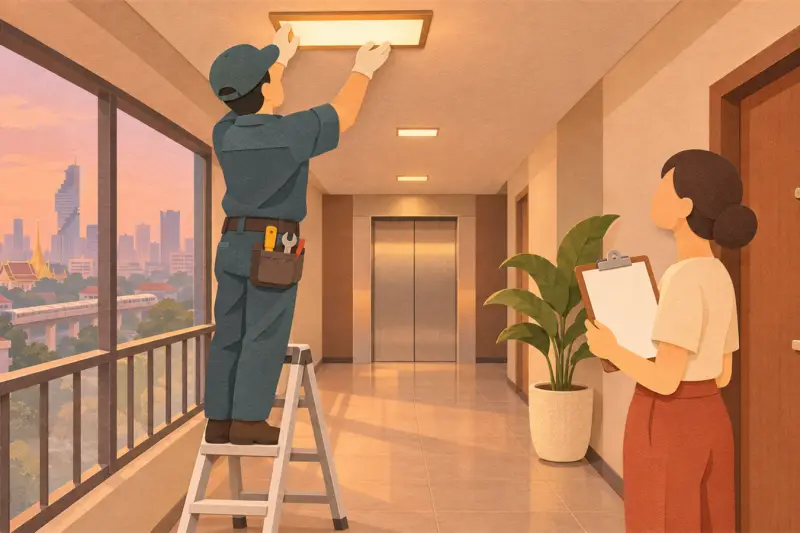
The short answer is that technicians working for the condominium juristic person mainly look after common property, such as lifts, corridors, the building's main electrical and water systems, fire protection systems and parking areas. Items inside individual units, such as air conditioners, water heaters, taps and power sockets, are the unit owner's private property. If you rent, responsibility for repairs inside your unit is shared between the owner and tenant according to the law and the tenancy agreement.
Some buildings offer maintenance services inside individual units, but this depends on each building's regulations and rules. It does not mean that building management must repair items inside your unit free of charge.
Why condo technicians do not repair everything in the building
The Condominium Act B.E. 2522 (1979) divides condominium property into two categories.
- Private property means individual units, including structures or land allocated to individual unit owners (Section 4).
- Common property means the parts of the building that are not individual units, the land on which the building stands, and property intended for shared use (Sections 4 and 15).
Section 33 states that the condominium juristic person's purpose is to manage and maintain common property. Section 18 requires co-owners to contribute to the costs of maintaining common property through what are commonly called common area fees. This money therefore pays for property everyone shares, rather than repairs to items inside a particular unit. (Source: Condominium Act B.E. 2522 (1979), consolidated version incorporating amendments, published by the Department of Lands, checked on 27 November 2026.)
Repairs normally handled by building management
Section 15 gives examples of common property, including the building's structure, equipment intended for shared use, and systems for safety or environmental conditions within the building, such as fire protection, lighting, ventilation, drainage and wastewater treatment. Problems you can usually report to building management include:
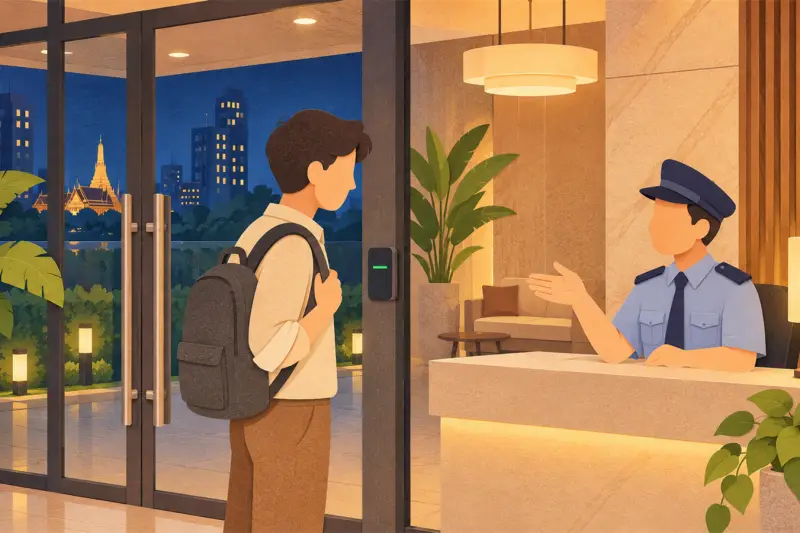
- Faulty lifts, communal doors or keycard readers
- Lights not working in corridors, fire escape stairwells or parking areas
- Leaks from communal pipes or blocked communal drains
- Damaged items in the swimming pool, gym or refuse room
- Cracks or structural problems in the building
Tenants can report these common property issues directly to building management.
Repairs inside the unit that concern the owner
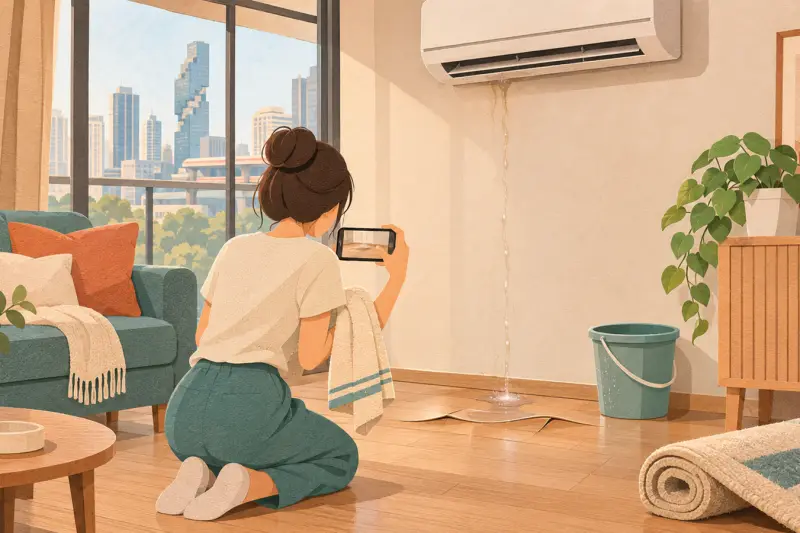
Items inside a unit that serve only that unit, such as air conditioners, water heaters, sanitary fittings, taps, sockets, light bulbs, built-in cupboards and the unit's door lock, are generally private property. Repairs are therefore the owner's responsibility, or are shared with the tenant under the tenancy agreement.
Confusion often arises over items at the boundary between common property and individual units, such as pipes running through several floors, or leaks from the unit above. The law provides that unit floors and walls separating units are jointly owned by the owners of the adjoining units, with their rights exercised in accordance with the regulations (Section 13). The precise boundaries therefore vary according to the building's design and regulations. The best approach is to ask building management to help identify the cause first, then discuss who is responsible for the repairs.
If you are a tenant, who pays for repairs inside the unit?
The Civil and Commercial Code sets out two principles. Section 550 makes the lessor responsible for defects arising during the tenancy and requires them to carry out necessary repairs, except repairs that the law or custom requires the tenant to undertake. Section 553 requires tenants to take care of the rented property as a reasonable person would their own property, maintain it and carry out minor repairs. (Sources: Section 550 and Section 553, checked on 27 November 2026.)
Landlords operating a rental business with 3 or more units fall under the Notification of the Contract Committee on Designating Residential Property Leasing as a Contract-Controlled Business B.E. 2568 (2025), effective from 4 September 2025. According to a summary by law firm Tilleke & Gibbins, the notification makes landlords responsible for repairs, except minor repairs arising from normal use, and prohibits contractual terms that make tenants liable for normal wear and tear. (Source: Tilleke & Gibbins, 26 August 2025.) An owner renting out just one unit may fall outside its scope, so the tenancy agreement is the main reference.
| Type of repair | Usually responsible | What to check |
|---|---|---|
| Lifts, corridors and communal systems | Condominium juristic person | The building's repair reporting channels |
| An air conditioner or water heater breaks down through normal use | Unit owner (landlord) | The repair clauses in the tenancy agreement |
| Minor tasks, such as replacing light bulbs or scheduled air-conditioner cleaning | Usually the tenant (minor repairs under Section 553) | The tenancy agreement and the condition at handover |
| Items damaged through the tenant's misuse or actions | Tenant | Evidence of the cause |
| A water leak with an unknown source | The cause must be identified first | Ask building management to help investigate |
This table is a general guide. What qualifies as a "minor repair" depends on the agreement and the individual circumstances.
General information, not legal advice.
In-unit maintenance services, if your building offers them
Whether building technicians can attend to problems inside your unit depends on the building's regulations and policies. Some provide an initial assessment, some charge for labour and parts at the building's set rates, and others do not undertake in-unit work and require you to call an external contractor.
Before a technician enters the unit, tenants should tell the owner what needs repairing, agree who will pay and clarify how reimbursement will work if the tenant pays upfront. Keep this agreement in writing, such as a message. Ask the building management office about permitted repair hours and registration requirements for external contractors.
How to report repairs and get things moving
- Identify where the problem is: inside your unit, in a common area, or not yet clear.
- For common property, report the issue through the building's designated channels and keep the reference number or a photo of the report form.
- For items inside your unit, message the owner with photos or a video and the date the problem started.
- For a water leak or electrical short circuit, turn off the water valve or circuit breaker if you can do so safely, then notify building management immediately, as the problem could affect other units.
- Agree on costs before work begins, and keep receipts and photos of the completed repairs for when you move out.
In an emergency, notify the building's security staff or management first. For a fire, call 199; for a medical emergency, call 1669; and for urgent incidents or crimes, call 191. (Source: Government Contact Information Centre, info.go.th, checked on 27 November 2026.)
Questions to ask before renting
Ask whether the building offers in-unit maintenance services and how charges work, what the tenancy agreement says about repairs, and how to contact the owner when something breaks. At handover, take photos and test the water, electricity and air conditioning from day one, following the move-in checklist. This evidence will help when discussing the return of your security deposit.
Summary
- Building technicians mainly maintain common property, in line with Section 33 of the Condominium Act.
- Items inside the unit belong to the owner. Necessary repairs are usually the landlord's responsibility, while minor repairs usually fall to the tenant, according to the law and the agreement.
- If the source of a problem is unclear, ask building management to help identify the cause first.
- In-unit maintenance services vary between buildings. Agree on costs in writing beforehand.
If you are looking for a rental, message our team on LINE at @korkaiidea. We can help you find a unit and ask about repair reporting procedures and tenancy terms before you decide. We respond in both Thai and English. Results are not guaranteed, and there is no need to rush. You can also browse currently available units in our rental listings.
Sources
- พระราชบัญญัติอาคารชุด พ.ศ. 2522 และกฎกระทรวงที่เกี่ยวข้อง (ฉบับรวมแก้ไข) - กรมที่ดิน, ตรวจสอบ 27 พ.ย. 2569
- ประมวลกฎหมายแพ่งและพาณิชย์ มาตรา 550 - Thai Law Online, ตรวจสอบ 27 พ.ย. 2569
- ประมวลกฎหมายแพ่งและพาณิชย์ มาตรา 553 - Legardy, ตรวจสอบ 27 พ.ย. 2569
- Thailand Strengthens Controls on Residential Lease Contracts - Tilleke & Gibbins, 26 ส.ค. 2568
- หมายเลขโทรศัพท์ฉุกเฉิน - ศูนย์รวมข้อมูลเพื่อติดต่อราชการ info.go.th, ตรวจสอบ 27 พ.ย. 2569