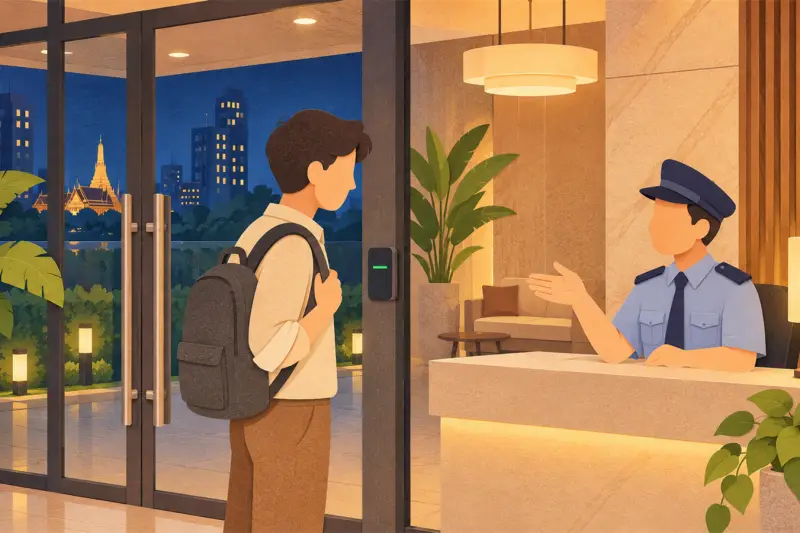
If you have forgotten your keycard late at night, a practical option is to speak to security or call the number provided by the building, show that you live in the unit, and ask for help opening the communal entrance or taking the lift, following the building's procedures. However, if the same card also opens your unit door, security can usually only help you get as far as your door. To enter the unit, you will need a spare key or card from the owner, or you will need to call a locksmith with the owner's consent.
This article explains what building management can help with, what falls to the owner, and what tenants need to do after that night.
First, check where you cannot get in and whether the card is forgotten or lost
Keycard systems vary between condos. Some cards only operate the lobby doors and lifts, while the unit door uses a key or code. Others use one card for the lobby, lifts and unit door. The solution therefore depends on the system.
| Situation | Who can help first | What to do next |
|---|---|---|
| You cannot enter the lobby or use the lift, but you have the key or code for your unit door | Security or the building management staff on duty | Confirm your identity, ask to be taken to your floor, then collect your card the next day |
| The card also opens your unit door, and it is inside the unit | The owner or a representative who holds a spare key | Contact the owner. If you cannot reach them, ask building management about the building's procedures |
| The card is lost, and you do not know where you dropped it | Building management | Ask for the old card to be deactivated as soon as possible, then request a replacement under the building's rules |
A lost card is more concerning than one left inside your unit because whoever finds it may be able to enter the building. An article on a condo rental website (published on 19 April 2026) explains that cards are usually configured by the building management office to link them to a unit and the floors accessible by lift. It recommends reporting a lost card immediately so it can be deactivated (superagent.co)
Who is responsible for what?
The condominium juristic person: building access and security systems
Section 33, paragraph two, of the Condominium Act specifies that the purpose of a condominium juristic person is to manage and maintain common property. Section 15(10) classifies structures or systems built to provide security within the condominium as common property, and Section 36(3) requires the manager of the condominium juristic person to arrange for security or the maintenance of order within the condominium (Text of the Condominium Act B.E. 2522, consolidated with amendments up to Act No. 4 B.E. 2551, published by the Department of Lands, checked on 27 November 2026)
In practice, lobby doors, lifts, card readers and security services therefore usually fall under building management's care. Helping residents enter the building after confirming their identity is something you can ask building management about. However, the procedure, such as who must be called for verification and what must be recorded, depends on each building's regulations and rules.
The owner: the unit door, keys and spare cards
Under Section 4 of the same Act, a condominium unit is the owner's personal property. The unit door and keys are therefore generally the owner's responsibility. Building management does not generally hold keys to every unit and should not open a unit for anyone without following a procedure accepted by the owner. If the owner has left a spare key with building management, you will need to check the agreed circumstances in which it may be used.
The tenant: looking after cards and keys under the tenancy agreement
Section 553 of the Civil and Commercial Code requires tenants to take the same care of the rented property as a reasonably prudent person would take of their own property (Text of Section 553, checked on 27 November 2026). Who pays for a replacement card or a locksmith largely depends on the tenancy agreement. If the agreement does not specify this, clarify it with the owner and keep the messages as evidence.
General information, not legal advice
What to do if you forget your keycard late at night
- Check thoroughly first Look in your bag and car, or ask someone sharing the unit whether they can come down and let you in. Sometimes this is all it takes.
- Go to the security booth or desk Or call the number provided by the building. Briefly explain which unit you live in and where you cannot get in.
- Have evidence ready to confirm your identity This could include an ID card or passport, the name registered with building management as a resident, or a copy of your tenancy agreement on your phone. Security may need to check the building's resident list first.
- Ask for a record to be made Note when the door was opened or you were taken to your floor, and who helped. This is useful for both you and the building.
- If you cannot enter your unit Contact the owner or the representative who holds a spare key. If you need to call a locksmith, obtain the owner's consent before the lock is drilled or replaced. Ask building management whether outside contractors are allowed in at night, and ask for the price before the locksmith starts work.
- The next day Contact building management during office hours. If the card is lost, ask for the old card to be deactivated and a replacement issued. Ask about the fee and required documents, and let the owner know too.
Why security may not let you in immediately
Security staff do not recognise every resident, especially tenants who have just moved in. Asking for evidence or making a verification call helps prevent outsiders from pretending to be residents to reach the residential floors. This also helps protect your unit. If it takes longer than expected, wait for the checks to be completed and speak politely.
You should not borrow someone else's card, follow a stranger through the entrance, or try to enter your unit through a balcony or window. These actions are dangerous and may breach the building's rules.
In an emergency
If someone inside the unit needs help, such as a child or an older person who is alone, or if you smell burning or see smoke, tell security or building management immediately that it is an emergency. Then call the relevant emergency service: 1669 (emergency medical services), 199 (fire emergencies) or 191 (police emergencies) (Thai PBS, 7 April 2024)
Prepare in advance to make the night easier
- Save the security and building management phone numbers on your phone when you move in.
- Ask building management how to confirm your identity if you forget your card outside office hours.
- Register everyone living in the unit with building management, including the tenant and anyone sharing the unit.
- Discuss with the owner how many sets of cards and keys there are, who holds the spares, and who pays if they are lost. Record this in the agreement or in chat messages.
- Keep copies of your tenancy agreement and identification on your phone.
If you are about to move into a new unit, these points are also covered in the viewing and moving-in checklist.
Summary
- If you forget your card late at night, speak to security or call the building's contact number, with evidence that you are a resident.
- Entrances, lifts and security systems are generally common property managed by the condominium juristic person, while the unit door belongs to the owner.
- If you cannot enter your unit, contact the owner before calling a locksmith, and do not risk trying another way in.
- If your card is lost, ask for it to be deactivated as soon as possible. Replacement fees and who pays depend on the building's rules and the tenancy agreement.
If you are looking for a rental, browse the properties currently available or contact the team on LINE @korkaiidea. The team can help you find units in buildings with clear management procedures, making it easier to choose a home, and can respond in both Thai and English.
Sources
- พระราชบัญญัติอาคารชุด พ.ศ. 2522 และกฎกระทรวงที่เกี่ยวข้อง (ตัวบทรวม เผยแพร่โดยกรมที่ดิน) มาตรา 4, 15, 33, 36
- ประมวลกฎหมายแพ่งและพาณิชย์ มาตรา 553 (หน้าที่ผู้เช่าในการสงวนทรัพย์สินที่เช่า)
- Thai PBS: อัปเดตเบอร์ฉุกเฉินที่ต้องรู้ (7 เม.ย. 2567)
- Superagent: กุญแจสำรองและคีย์การ์ดในคอนโดกรุงเทพฯ (19 เม.ย. 2569)